The match-3 that set the template for the whole genre — swap, combine, and clear thousands of hand-built levels.
Candy Crush Saga has been on phones for over a decade and it is still the reference point everyone else is measured against. The pitch has not changed: swap two neighbouring sweets to line up three or more of a colour, clear the board's objective before the moves run out, and move one step further along a map that now runs into many thousands of levels. What has changed is how much has been layered on top of that idea, and whether the result is still worth installing in 2026. Having played the first two hundred levels again from a fresh account, the answer is a qualified yes.
How it plays
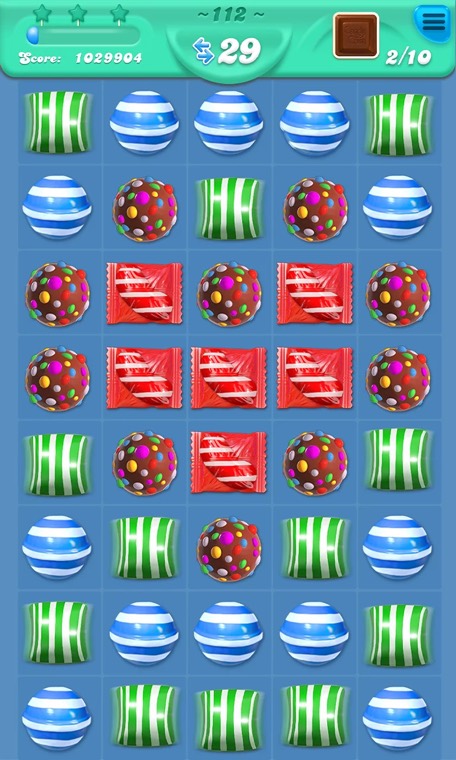
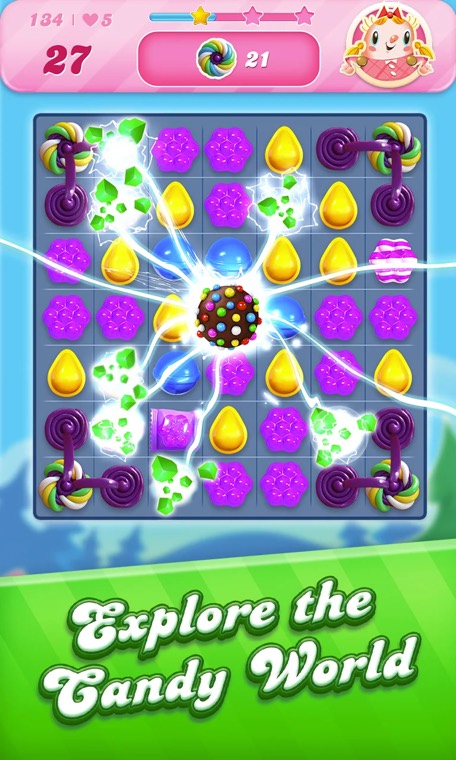
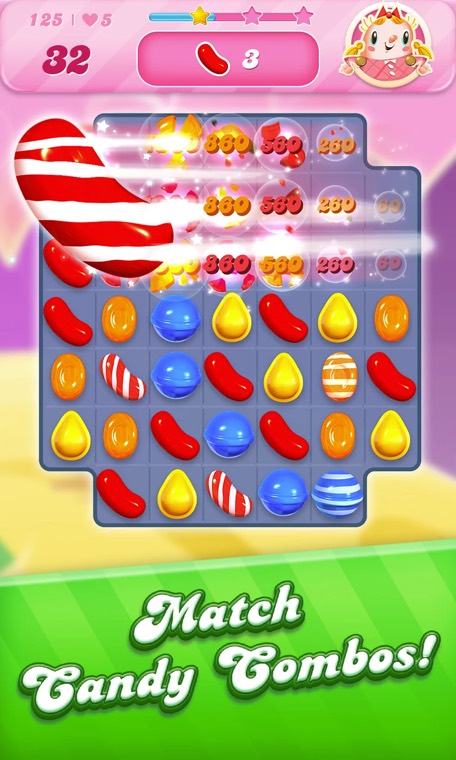
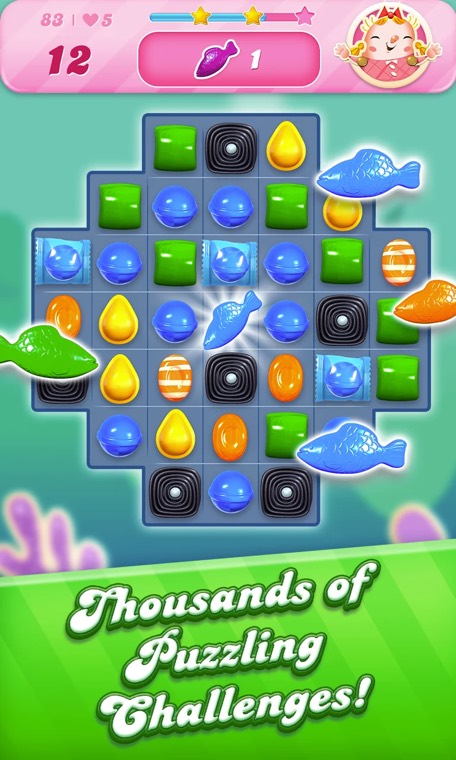
The board is a grid of coloured sweets. You drag one sweet into an adjacent square; if the swap creates a line of three or more matching sweets, that line clears, everything above it drops down, and any new line formed by the falling pieces clears too. That is the entire base rule, and it is the reason the game is so easy to hand to someone who has never played a puzzle game before.
What makes it a puzzle rather than a toy is the special pieces. Matching four in a straight line produces a striped candy that clears an entire row or column when it is next matched. An L or T shape of five produces a wrapped candy that explodes twice in a small area. Five in a straight line produces a colour bomb, which removes every sweet of whatever colour you swap it with.
The interesting part is combining two of them. A striped and a wrapped candy swapped together produce a giant three-row-wide sweep. A colour bomb with a striped candy turns every sweet of that colour into a striped candy and detonates them all. Two colour bombs together clear the entire board. Learning to build and hold these combinations is the single biggest skill jump available in the game.
The level types
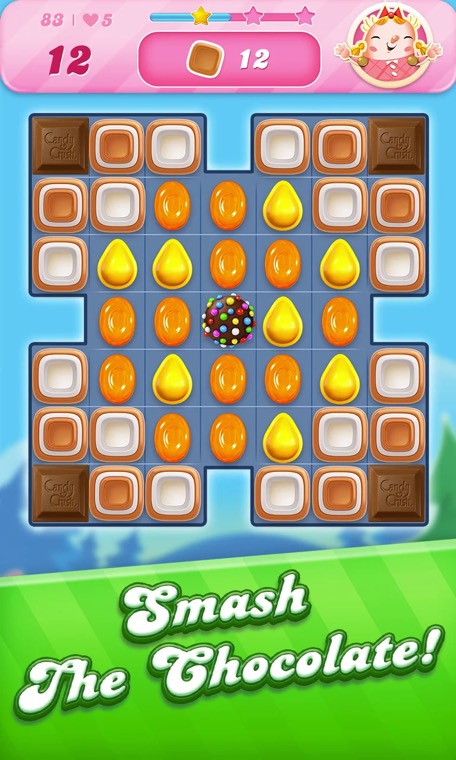
Candy Crush cycles through a handful of objective types, and knowing which one you are on changes how you play completely:
- Target score — reach a points total within a move limit. The most forgiving type; special candies matter more than position.
- Clear the jelly — remove the coating from marked squares. You must match on top of the jelly, so where you clear matters far more than how much you clear.
- Ingredients — bring cherries and hazelnuts down through the board to exit points at the bottom. Clearing pieces beneath the ingredient is the whole game here; clearing above it wastes a move.
- Orders — collect a stated quantity of specific pieces or special candies. Often the hardest to plan, because the order may require you to make special candies rather than use them.
The single most common mistake. Playing every level as though it were a score level. On a jelly or ingredient level the biggest match on the board is frequently the wrong move. Read the objective panel at the start — it is displayed for a reason.
Difficulty, lives and the money question
You have five lives. Failing a level costs one, and they refill over about half an hour. In the first hundred levels this almost never bites. Somewhere after that, the game starts placing deliberately hard levels before episode boundaries, and that is where the design gets more commercial: a failed attempt is followed by an offer of extra moves for gold bars, which can be bought.
It is entirely possible to finish those levels without paying — we did, repeatedly — but it takes patience, and the game is very good at making patience feel expensive. That is the honest trade in this genre, and Candy Crush is neither the worst nor the best example of it.
The one genuinely generous mechanic is Sugar Crush: finishing a level with moves left over converts each remaining move into a striped candy that detonates for bonus points. If you are chasing three stars rather than just a clear, finishing efficiently is worth more than any single big match.
Does it still hold up?
Yes, with a caveat. The core puzzle is genuinely good and the level design in the first several hundred levels is careful, varied and fair. The interface, on the other hand, has accumulated a decade of events, passes, chests and pop-ups, and a new player in 2026 will spend the first ten minutes dismissing things. Push through that and the game underneath is still the best-made match-3 on the store.
Tips that actually made a difference
- Read the objective first. It takes two seconds and it prevents the most common cause of a failed level.
- Match at the bottom of the board. Everything above a low match falls and often creates free chain matches. Matches at the top rearrange almost nothing.
- Never use a colour bomb on its own. Swapping it with an ordinary sweet is the weakest possible use. Save it until you can pair it with a striped or wrapped candy.
- On jelly levels, clear the corners early. Corner and edge squares have the fewest possible matches. Leaving them to the end is how levels are lost with three jellies remaining.
- On ingredient levels, look down, not around. Only the pieces underneath an ingredient matter. Clearing a big match to one side achieves nothing.
- Let the board settle before your next move. Chain reactions frequently create a special candy you did not plan. Tapping too fast means you never see it.
- Finish with moves to spare. Sugar Crush converts leftover moves into bonus points, which is usually the difference between one star and three.
The honest summary
What works
- The clearest tutorial in the genre — genuinely playable by anyone
- Special-candy combinations are deep and satisfying to learn
- Enormous level count, and the early hundreds are well designed
- Runs smoothly on old and low-end Android phones
- Completable without spending money if you are patient
What grates
- The interface is cluttered with events, passes and pop-ups
- Deliberate difficulty spikes before episode boundaries feel commercial
- Live-refill waits are frustrating once you hit a wall
- Some later objective types repeat with only cosmetic variation
Verdict. Still the benchmark. If you have never played a match-3 on a phone, this is the one to start with, and the first few hundred levels are a genuinely well-made puzzle game. Budget a few minutes of pop-up dismissal on first launch, turn the notifications off, and it settles into something you can dip into for years.
Download. Candy Crush Saga is free to install from Google Play and contains optional in-app purchases. We earn nothing from the link below — it points at the official listing by King.